

How to Hike Faster Without Getting Fitter
There’s a moment on every adventure where something shifts.
It’s not at the summit. It’s not in the photo. It’s not even when the view opens up.
It’s earlier than that.
It’s when the group settles into rhythm. No rushing. No scrambling. No stopping every five minutes.
Just steady, capable movement.
And here’s what most people don’t realise: You don’t necessarily need to get fitter to hike faster.
You need to hike smarter.
Over the years of leading multi-day hiking adventures all over the world, I’ve seen it again and again. The women who move well and cover ground efficiently are not always the fittest. They’re the most consistent in the small habits.

Below are five habits that make a bigger difference than most people expect.
1. Don’t Stop Completely on the Uphill
When the trail tilts upward, the instinct is to stop.
Instead, shorten your stride and slow your pace, but keep moving.
A “micro-recovery” while still walking maintains circulation and momentum. Stopping fully means your heart rate drops, your legs stiffen, and restarting feels harder. (and we always want one more minute)
On longer climbs, that stop/start pattern costs more energy than steady movement.
This one shift alone can change how a climb feels.
2. Restart Well
How you begin walking after a pause matters.
Strong hikers don’t ease back in hesitantly. They reset their posture, engage their core, and move off with purpose.
That first 10-20 seconds after a stop sets your rhythm again.
If you restart slowly and loosely, you’ll drift. If you restart with intention, your body remembers the pace.
It’s a skill. And like all skills, it improves with repetition.

3. Pack Before the Boots Move
Watch experienced hikers during a break.
They quietly put their water bottle away and finish their snack. Pack goes on and poles are adjusted. Then they stand ready.
Then they hike.
No lingering. No rummaging. No last-minute adjustments.
It sounds minor, but on a multi-day hike, those transitions add up.
Prepared transitions protect group rhythm and conserve energy both mentally and physically.
4. Manage Your Breath Early
If you wait until you’re gasping to think about breathing, you’re already behind.
The strongest hikers regulate their breathing before it becomes strained.
Slow the inhale. Lengthen the exhale. Match breath to steps.
Breath control stabilises effort. It keeps you calm. And calm hikers move efficiently.
5. Trust the Pace
Many hikers speed up unnecessarily.
They overtake. They push the downhill. They surge on flatter sections.
Then they fade.
Efficient hiking isn’t about bursts. It’s about consistency.
Trusting a sustainable pace, especially in a group, prevents energy leaks.
And energy leaks are what slow people down.
The Real Difference
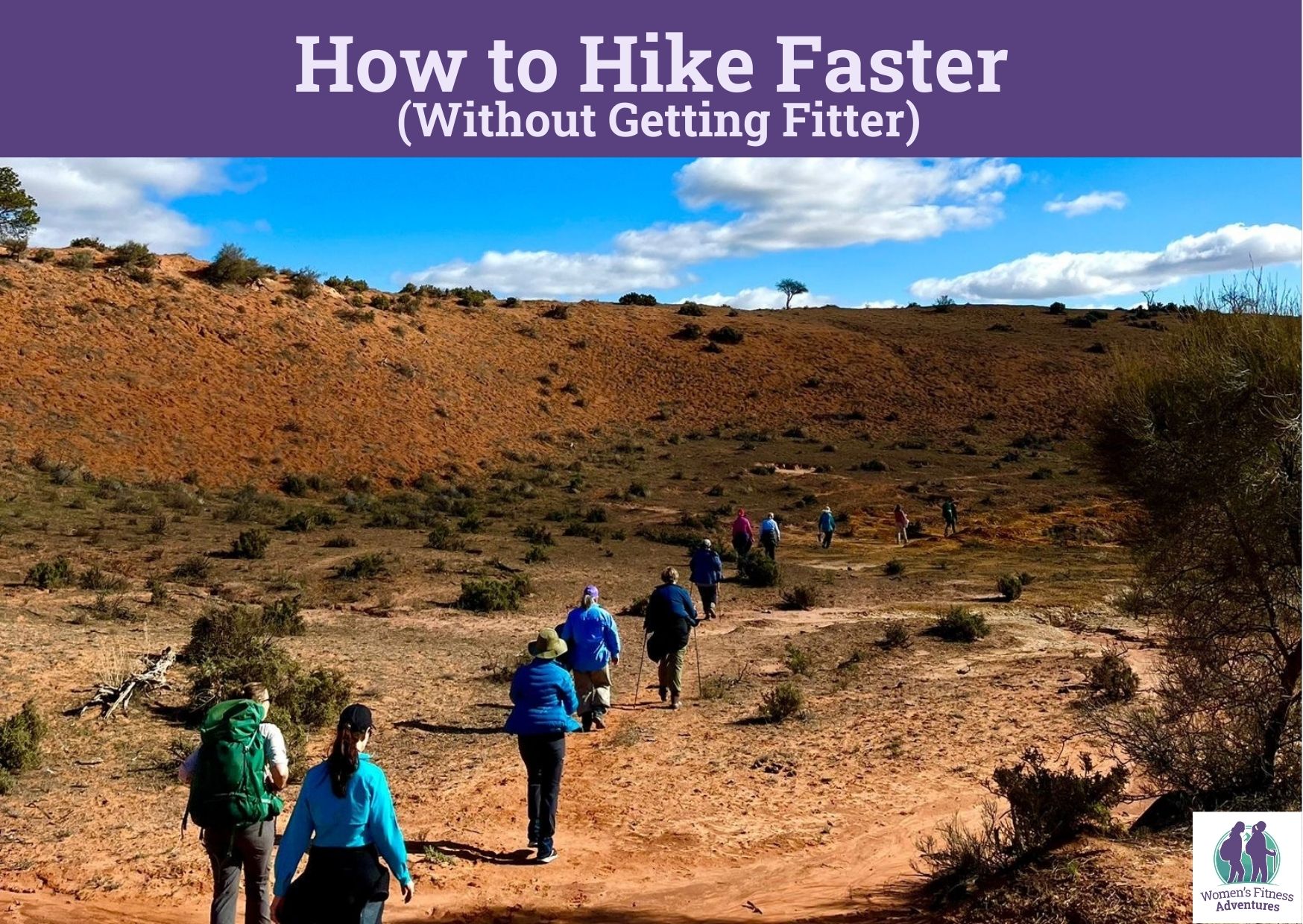
On recent adventures, I’ve watched groups move across varied terrain – scree, boardwalk, sand, long inclines and what stands out isn’t brute fitness.
It’s rhythm.
It’s the quiet confidence of women who prepared months earlier. Who trained. Who practised. Who repeated small habits until they became automatic.
That preparation doesn’t show up in the summit photo.
But it’s the reason the photo happens calmly instead of chaotically.
You can’t see consistency.
You can see the result of it.

Small Habits. Big Difference.
If you’re looking to improve your hiking pace, don’t immediately assume you need more kilometres or harder gym sessions.
Often, the gains are behavioural. How you pause. How you restart. How you breathe. How you transition.
How you pace yourself in a group.
These are learned skills.
And they compound.
Want to See This in Action?
I recently recorded a full video breaking these five habits down in more detail, with practical examples of how they play out on the trail.
If you’re serious about improving your hiking pace, it’s worth watching.
Watch the full video on YouTube here.
Because reading about rhythm is one thing.
Seeing it, and recognising yourself in it, is another.
And If You Want to Practise It
Understanding the habits is helpful.
Practising them consistently is what changes how you hike.
Inside our membership, we teach hiking-specific fitness online, so you can participate wherever you live.
We don’t just build strength.
We practise transitions.
We build steady pacing.
We work on breath control under load.
We build the kind of endurance that supports calm, consistent movement on the trail.
Because hiking fitness isn’t only about stronger legs.
It’s about moving well, for hours or for days, with confidence.
If you’d like to train this in a structured, supportive environment (without needing to live near us), you can learn more about membership here:
Explore membership.
Prepared hikers move differently.
And preparation can happen anywhere.
To learn more about becoming a Member of the Women’s Fitness Adventures Community, click here.